Showing posts with label Living Wage. Show all posts

Wednesday, 24 April 2013

Say no to rural poverty | Save the Agricultural Wages Board

Government proposals to scrap the Agricultural Wages Board should be opposed. AWB is vital in protecting living standards and wages of agricultural workers. 

Agricultural industry is a significant part of the East Midlands economy and those working in it should have decent pay, conditions and protection from exploitation. 

Find out more: www.unionstogether.org.uk

Saturday, 6 April 2013

April Fools' Day was no joke


For those of us who care about living standards Monday of this week, 1 April, was no joke. April Fools’ Day it may have been but for people on the receiving end of the government’s savage clobbering of the welfare system that day will have very real consequences.

As if that were not enough, a day later we see coalition ministers apparently considering freezing or cutting the national minimum wage. This was well past the threshold for April Fools’ Day wind-ups. Freezing or cutting the national minimum wage would be outrageous and would have a devastating impact on living standards.

As the government was setting about wrecking the welfare system, this week, Labour-led Leicester city council increased the pay of 1,100 staff to the level of the living wage. This includes over 280 kitchen assistants and 270 cleaners. We committed to this in our manifesto, it was recommended by the Leicester Child Poverty Commission and I am pleased we have delivered it.

It won’t stop the coalition’s devastating welfare changes but it will make some difference to those workers and their families. It will strengthen our hand in encouraging other employers to pay the living wage. We have seen strong campaigns for the living wage. In Leicester, Labour Students at the university have run an excellent campaign and there are many others like it across the country. This movement needs to continue with energy and determination.

The living wage has become a practical example of how Labour councils are doing their bit to help and deliver fairness in these tough times. As the coalition continues to create hardship and misery for hard-pressed families it will fall to Labour councils to help. It will fall to the next Labour government to pick up the pieces. The living wage can play a big part in this. As Labour we have always, and will always, be about lifting living standards and protecting workers from poverty pay.

There is a compelling argument for the living wage to be central to Labour’s economic and social priorities and a cornerstone of our next manifesto. We have to make the case for the living wage but it now seems to do that we may have to fight to defend the minimum wage: this argument is one and the same.
It is an argument we must win.

This article was published by Progress, 5 April 2013.

Monday, 1 April 2013

Living Wage: implemented today at Leicester City Council

Today (1 April 2013) 1100 staff at Leicester City Council will see their pay increase to the level of the Living Wage.

I have blogged previously on this here.

I am pleased that as a Labour administration we have delivered this. I argued for a commitment to the Living Wage in our manifesto for the city council elections in 2011. Adopting the Living Wage for the lowest paid council staff is the first step.

The next and important challenge is to work to encourage other employers, in the public, private and voluntary sectors, to do likewise. This will include exploring ways to encourage organisations contracted by the city council to pay the Living Wage as well.

Initially at the city council the Living Wage will be paid as a supplement to pay, this is the quickest way of implementing the Living Wage from the start of this financial year. It means that 1100 staff will see their pay increase from today, this includes over 280 kitchen assistants and over 270 cleaners.


Leicester Mercury article on Living Wage at
Leicester City Council.


Sunday, 3 March 2013

Living Wage

From 1st April this year Leicester City Council will be paying the Living Wage.

I am really pleased that we have agreed to deliver this. I argued for a commitment to explore paying the Living Wage in Labour's manifesto for the 2011 city mayor and council elections.
Paying the Living Wage was also included in the recommendations of the Leicester Child Poverty Commission which I chair.

On Friday I signed the formal decision notice confirming that the council will be paying the Living Wage from 1st April this year.

Signing the formal decision notice confirming (see below)
that Leicester City Council will pay the Living Wage


From page to practice. The work of Labour councillors delivering fairness in tough times.


Labour councillors and activists know that it is an understatement to say local government has had a raw deal from the coalition. Councils have seen their budgets slashed, with poorer areas losing out disproportionately. There are new risks built into local authority revenues via business rates retention. Localised council tax discount schemes and housing and welfare benefit changes will hit low-income households hard. For those who care about reducing hardship and poverty and who want to create fairer communities the landscape could not be tougher.

Against this challenging and bleak backdrop Labour councillors are doing their utmost to protect communities and secure progressive change. The living wage movement has taken hold in Labour local government. Labour councils across the country are introducing the living wage and those early adopters should be applauded. More councils will do so in the coming months, 
including my own in Leicester.


Commissions which bring together those who share our broad commitment to fairness and social justice have been set up in a number of Labour-run areas. Islington set the ball rolling with their landmark Fairness Commission and others including Sheffield and York have followed. In Leicester I set up a commission to explore what more can be done to tackle high rates of child poverty, which are forecast to get worst because of welfare changes.

As a model of working, commissions are proving to be useful. They allow for the exchange of ideas and joined-up working towards local solutions which will help drive out inequalities and disadvantage. Crucially, commissions are able to actively demonstrate a shared commitment to a fairness agenda both in concept and delivery.

The coalitions which are brought together through commissions and similar partnerships are key in taking recommendations from page to practice. My experience in Leicester is that we will implement some of our 66 recommendations on child poverty quickly because we had people round the table framing those proposals who can now provide important tactical input in getting them delivered. This includes the voluntary sector and private sector, showing that through this model of working it is possible to develop important relationships across sectors around key priorities. This in itself provides a mandate which can generate momentum around particular priorities or recommendations.

One of the lessons from this experience is that some of the best of what happens in local government happens when we look outwards. Labour councils are determined not to retreat in these tough times. It is clear that when we engage our communities and partners and set out to work cooperatively to find solutions we can make important progress.

This is not the ‘big society’ and attempts to badge this approach as such would be wrong. This is the best of Labour in local government, working with our communities to tackle inequality and build fairness. Labour in local government is showing that whatever the coalition can throw at us we won’t turn our backs on those we represent. We will work with our communities in the best traditions of cooperative endeavour to champion fairness and social justice.

This article was first published to coincide with the Labour Local Government Conference and the publication of One Nation Localism by Jessica Studdert.

Saturday, 26 January 2013

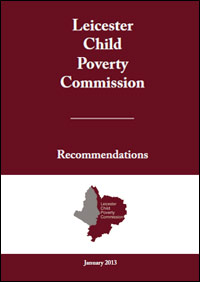
Leicester Child Poverty Commission: recommendations published

Yesterday the recommendations of the Leicester Child Poverty Commission were launched.

I chair the Leicester Child Poverty Commission, which I set up in June 2011. According to official figures there are over 26,000 children in Leicester living in poverty, with many more growing up in low income households.


The report published yesterday sets out 66 recommendations, including:

  • Leicester City Council maintaining its network of Children's Centres across the city (despite the severe government funding cuts) - this is something Labour committed to do in our 2011 manifesto in the city elections.
  • Payment of the Living Wage across the public sector.
  • Piloting through a social enterprise or other provider the provision of packed lunches in place of free school meals during school holidays.
  • Developing a partnership between the city council and other organisations to provide low cost loans for household essentials, such as beds and whitegoods.
  • Automatic library membership for children starting nursery school in the city.
I am grateful to the members of the Leicester Child Poverty Commission and all those who have contributed to our work. The important work starts now as we work with partners to implement our recommendations.

With child poverty predicted to increase this challenge is urgent.

The recommendations can be read and downloaded from the commission's webpages.

The Leicester Mercury reported on the publication of these recommendations, and the paper's editorial supported this work.